


Car chases
A high-speed police chase needlessly puts DC residents at risk.
- 6 Minute Read
Car chases – high-speed police pursuits of an individual – are deadly actions. At least 3,336 people died in police car chases in the U.S. between 2017 and 2022, including at least five individuals in DC. Black people are killed in police chases at a rate four times that of white drivers. DC passed legislation that would have banned chases unless the officer reasonably believed the pursuit wouldn’t cause death or serious injury or was necessary to avoid death or serious injury. DC rolled back this change by creating an exception to abandoning the pursuit to save any life if the person is a “fleeing suspect or suspects” – something that could exonerate officers otherwise found guilty in cases leading to someone’s death. The U.S. Park Police also removed guardrails limiting car chases, which has resulted in residents being killed or seriously injured. Other places, like Los Angeles, Phoenix, and Orlando, reducing police chases without seeing escalations in crime. Maryland’s Attorney General is currently investigating statewide car chase policies. DC should limit car chases to the safest and most serious cases.

What you need to know
High-speed car chases by police lead to needless deaths.
The U.S. Justice Department has said that vehicular pursuits are “the most dangerous of all ordinary police activities.” Car chases may result in property damage, injury, and death. High-speed chases put individuals involved in the pursuit, including unrelated drivers, cyclists, and pedestrians, at risk. The San Francisco Chronicle showed that at least 3,336 people died in pursuits in the U.S. between 2017 and 2022. During that timeframe, Black people were four times as likely as white people to be killed in police pursuits. This was consistent whether the person killed was a driver or suspect (45 percent of the time), a passenger (27 percent of the time), or a bystander (27 percent of the time). Research published by the Police Executive Research Form suggests that if the police did not chase people, there would be no significant increase in the number of suspects who flee. If police disengaged from a pursuit rather than keep driving dangerously, 75 percent of suspects surveyed after a car chase said they would have slowed down when they felt safe.
Most police chases begin with a traffic violation, not a violent crime.
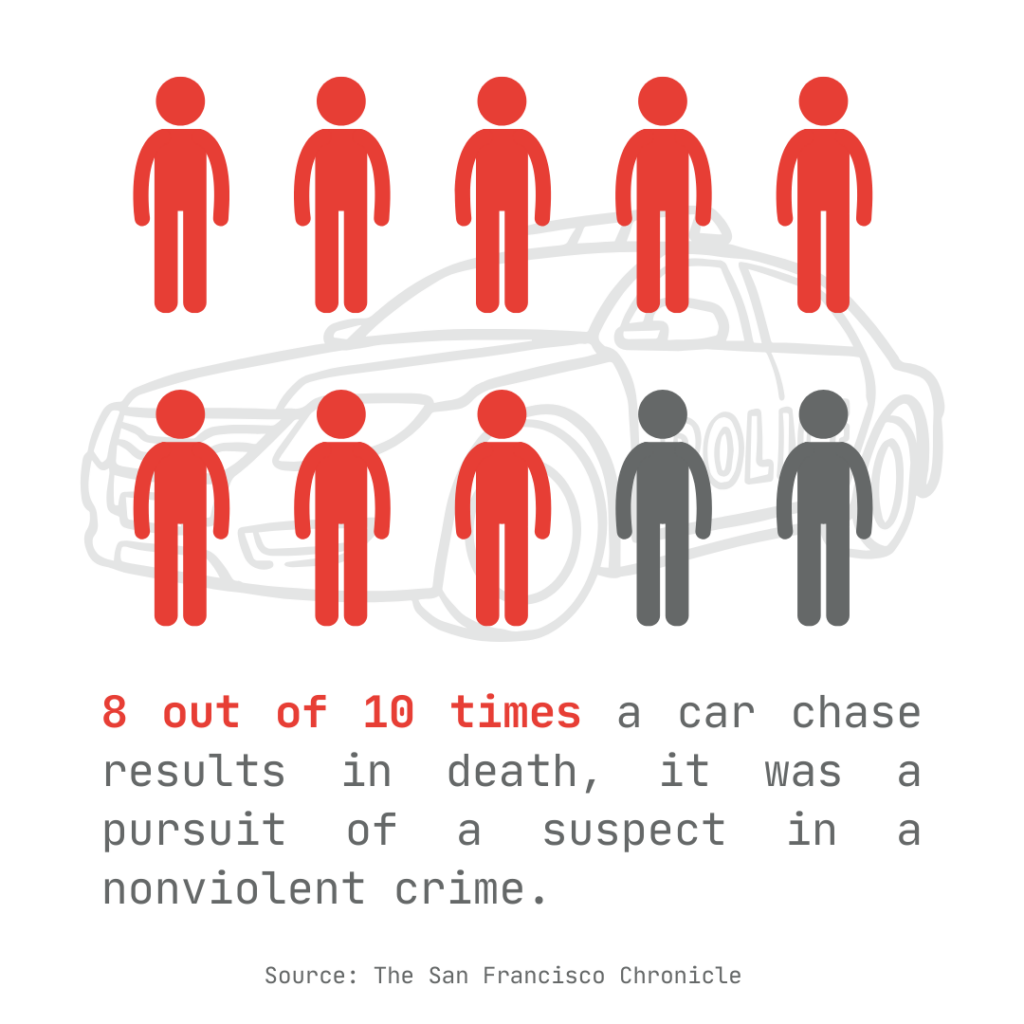
Between 2017 and 2022, 82 percent of the time, a car chase resulted in a death, it began as a pursuit over a traffic stop or because the suspect was being pursued for a nonviolent offense. Only 15 percent of car chases leading to death over this period were a pursuit of someone being suspected of engaging in a violent crime. The California Highway Patrol found that in 2020, half of all police pursuits in the state were initiated in response to four non-violent offenses: speeding (20.7 percent), stolen vehicles (13.6 percent), license plate/vehicle registration violations (8.8 percent), and red light/stop sign violations (7.5 percent).
save & share ⤴
DC has proportionately more car chases, which disproportionately involve Black residents.
DC ranks 18th out of 51 jurisdictions in the United States for the highest number of police car chase fatalities, outpacing places like Louisiana, Maryland, and West Virginia for the number of individuals killed in a chase per one million residents. Black people are four times more likely to be killed in police car chases than white people. In DC, since 2017, four out of five people killed in police car chases, whose race was known, were Black. The victims of these car chases include the families of Karon Hylton-Brown, Jeffrey Price, and An’Twan Gilmore. Some of these families have claimed that the Metropolitan Police Department targets Black bikers – chasing them at high speeds and knocking them off of their motorbikes. More than 230 sworn affidavits from DC riders support their claims.
The Metropolitan Police Department has policies to restrict car chases – but does not always follow them.
Because of the danger that high-speed chases pose, the Metropolitan Police Department (MPD) has joined other agencies in developing policies to limit the practice. Current MPD policy permits vehicle pursuits only in extremely limited circumstances and forbids officers from intentionally using their vehicles in ways that can cause harm. However, these policies are not always adhered to. An MPD Captain sued DC after he alleged that he was retaliated against for rejecting an officer’s request to engage in a high-speed pursuit of an individual suspected of non-violent theft, as it violated MPD pursuit policy: The chase that resulted saw a car flip over and injuries both occupants, one of whom was 16 years old.
Car chases are only one form of reckless driving observed by DC police.
Vehicle pursuits are not the only form of dangerous driving exhibited by the police. MPD officers have a demonstrated record of unsafe driving in Washington, DC. In April 2021, four on-duty MPD officers used police vehicles to drag race in a predominantly Black residential neighborhood, resulting in two severely damaged MPD cruisers, damage to a residential property, and injuries to the officers involved. In July 2017, an MPD cruiser rear-ended a vehicle while responding to a call, damaging the car and injuring the driver.
The DC Council has not banned car chases.
In 2022, the Council of the District of Columbia unanimously made it illegal to chase a car unless the officer reasonably believed the chase wouldn’t cause death or serious bodily injury to any person. However, in 2024, as part of Secure DC, an exception was made for when the chase puts the suspect’s life at risk. This gives the police more latitude than they had in the past to engage in a dangerous pursuit, move away from the notion of officers asking, “is this chase necessary” before it begins, and could lead to the exoneration of police officers in cases that have led to someone’s death.
Places that have restricted car chases have not seen higher crime rates.
Cities that have implemented more restrictive policies on car chases, such as Los Angeles, Phoenix, and Orlando, reduced police pursuits and associated injuries and deaths without seeing escalations in crime. The Police Executive Research Form (PERF) studied the issue in 2023 and wrote, “Over the years, we’ve also learned that not everyone flees when there’s a restrictive policy in place, and crime rates do not necessarily spike. Some cities have witnessed increases in car thefts and subsequent police pursuits, and proponents of pursuits attribute these upticks to the restrictions on chasing [individuals]. However, there’s no evidence to support the notion that changes in pursuit policies are fueling these thefts.”
Changes to federal rules have led to dangerous car chases in DC by U.S. Park Police.
In response to fatalities and injuries due to car chases, in 2020, the United States Park Police amended its policy on vehicular pursuits: That general order on pursuits emphasized that the U.S. Park Police could only chase subjects wanted for violent felony offenses, and it removed a sentence giving federal police discretion to chase someone if they alone determine that person “presents a clear and immediate threat to public safety.” In August, 2025, the U.S. Secretary of the Interior, who oversees the U.S. Park Police, announced that the rules had been changed to give much more discretion to engage in a high speed pursuit: the Secretary said, “the next night [after the rule changed], they [the U.S. Park Police] had so much fun pulling people over, they started to take off, and they chased them.” Within three weeks of the rule change, the U.S. Park Police initiated at least 10 car chases, six of which ended in collisions. Within eight weeks of the change, one law firm said that by their accounting, the U.S. Park Police had conducted 22 car chases, 18 of which resulted in crashes. In 2026, there have been at least five car chases initiated by U.S. Park Police that have harmed residents: These car chases have resulted in a crash and brush fire, led to an individual’s death, led to an individual being paralyzed, and led to the death of a delivery driver on a moped. The Mayor of the District of Columbia, who has been criticized for the city’s response to the death of an individual during an MPD police car chase in 2025, said the federally initiated car chases were a matter of “grave concern.”
WHERE TO LEARN MORE
DC Justice Lab October 2025
The San Francisco Chronicle September 2024
The San Francisco Chronicle February 2024
Salon February 2019
Greater Greater Washington May 2021
Superior Court of the District of Columbia April 2022
The Washington Post April 2022
Police Executive Research Form September 2023
The Baltimore Sun June 2024
WUSA June 24, 2026
Our Solutions
DC and federal law enforcement agencies should prohibit car chases unless the officer reasonably believes it is immediately necessary to prevent death or serious bodily injury to any person, including the person who is being chased.
special thanks
Phoenix Ricks ★ Jay Brown